
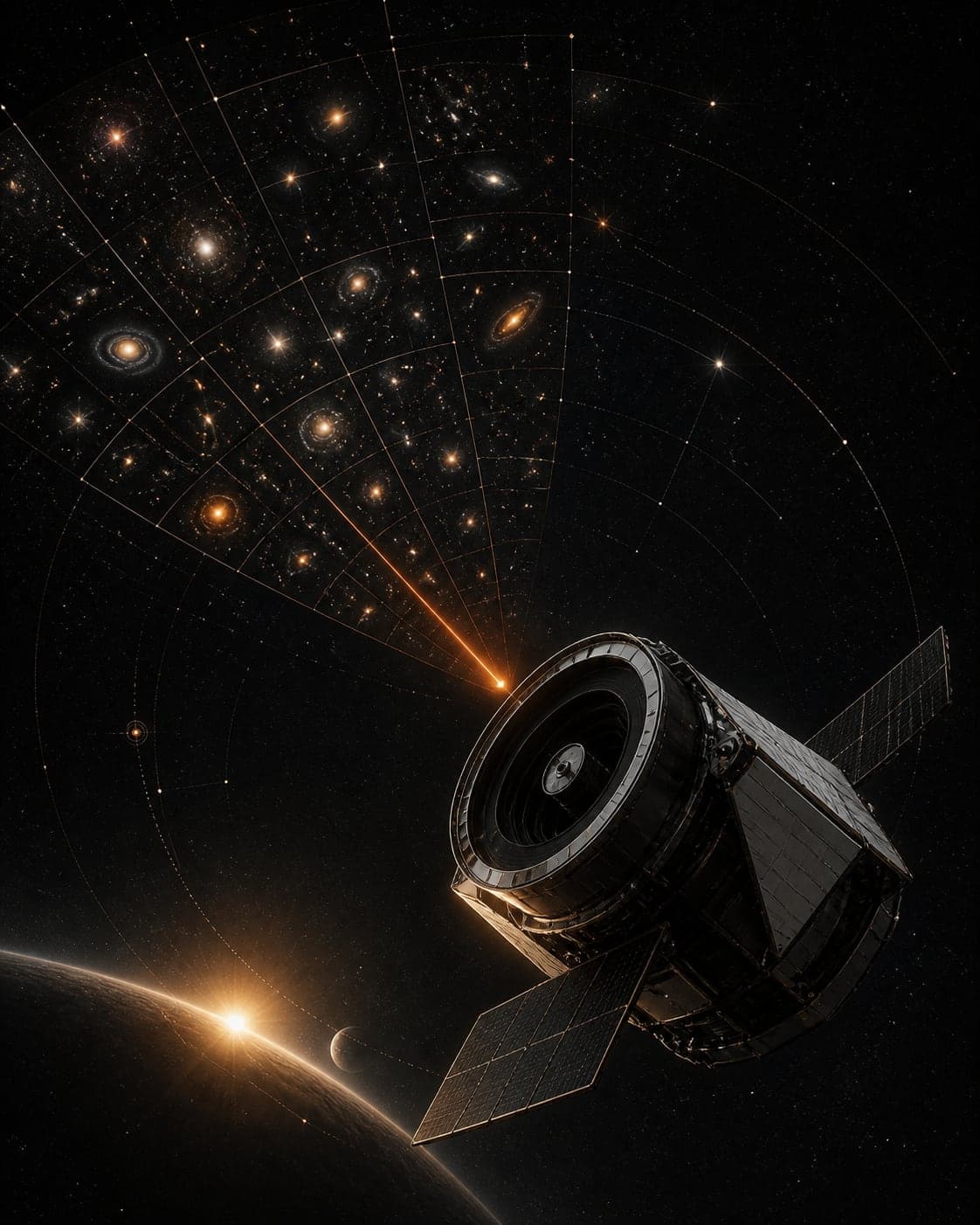
NASA's next flagship astrophysics observatory is almost at the starting line. The agency and SpaceX are targeting no earlier than 7:26 a.m. EDT on Sunday, Aug. 30, for the Nancy Grace Roman Space Telescope to lift off on a Falcon Heavy from Launch Complex 39A in Florida.
The launch time is still a target, not a promise. Weather, hardware readiness, or real-time range operations can move the clock. That caveat matters for a daily briefing: the durable story is the observatory now entering its final launch sequence, not an assumption that liftoff has already happened.
Roman combines crisp infrared vision with a field of view at least 100 times larger than Hubble's. Instead of building a cosmic picture from a narrow set of deep exposures, astronomers will be able to survey broad regions with comparable sharpness and assemble a far larger statistical view of the universe.
Those surveys are designed to investigate dark energy and dark matter, map billions of galaxies, trace black holes, and build a census of planetary systems. The mission also carries a coronagraph technology demonstration aimed at improving the direct study of planets around other stars.
After separation, Roman will travel toward the second Sun-Earth Lagrange point, roughly one million miles from Earth. NASA expects deployments, calibration, and testing to take about three months and currently forecasts the first science images for early 2027.
The primary mission is planned for five years, with a goal of operating for 10. Just as important for the broader research community, NASA says Roman's processed science data will be public. The signal is not one dramatic image; it is a new panoramic data engine for astronomy.