
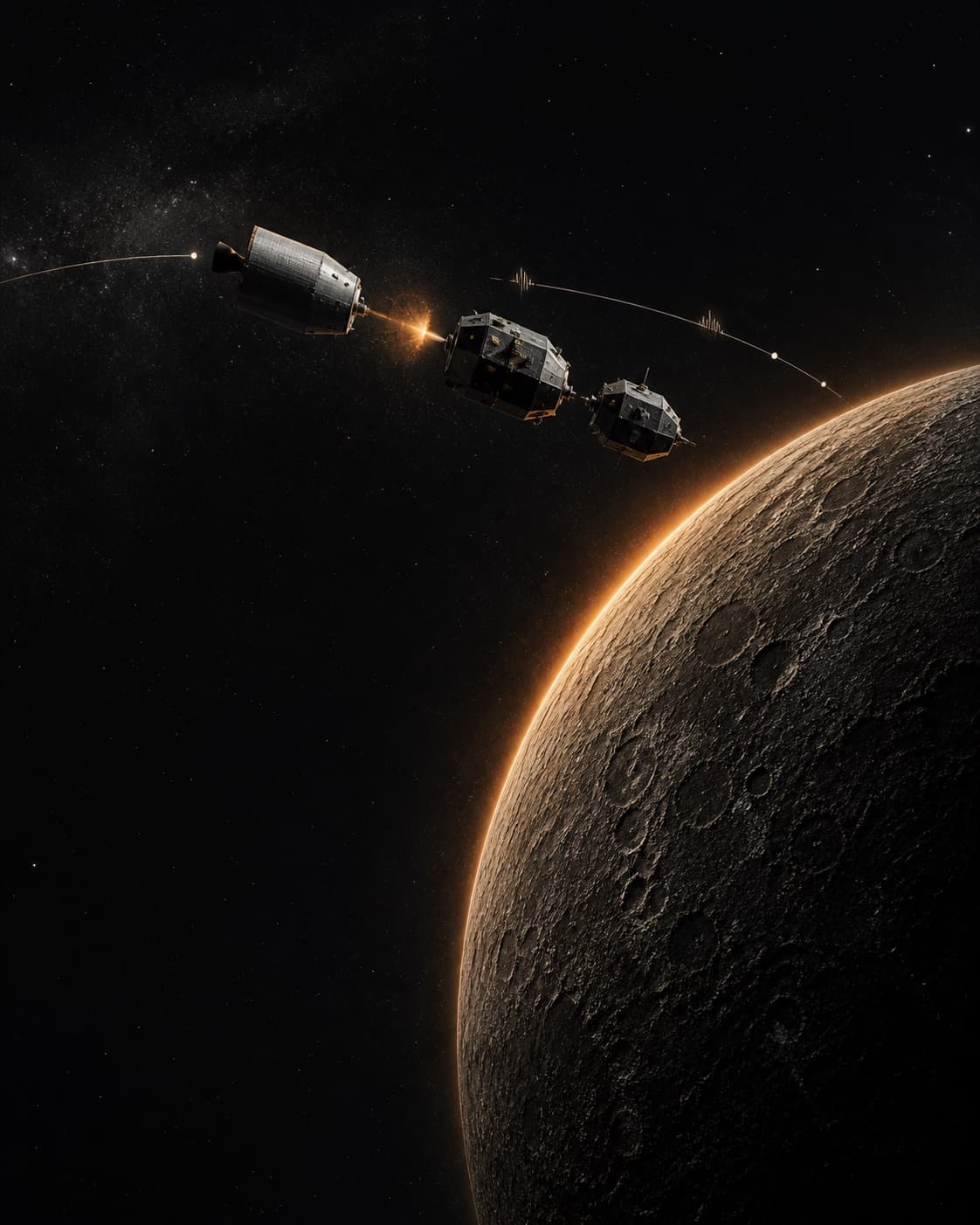
After eight years of interplanetary travel, BepiColombo is approaching the most demanding part of its journey. The joint European Space Agency and Japan Aerospace Exploration Agency mission is beginning its Mercury Arrival Phase, a tightly choreographed sequence that is planned to turn one stacked spacecraft into two science orbiters around the innermost planet.
The first major step is scheduled for September 3. ESA's Mercury Transfer Module, which has carried and powered the spacecraft stack during the cruise, is expected to separate from the two science orbiters. ESA plans to broadcast the operation from mission control, with separation scheduled for 14:00 CEST and the earliest post-separation signal acquisition expected at 15:53 CEST. The agency warns that those times can change at short notice.
Signal acquisition is the immediate proof point. Once the transfer module has moved away, ground teams must hear from the remaining spacecraft and check that it is healthy before the arrival sequence can continue. The operation should therefore be understood as scheduled, not already completed.
The surviving stack contains ESA's Mercury Planetary Orbiter and JAXA's Mercury Magnetospheric Orbiter, known as Mio. ESA's published timeline calls for the pair to enter Mercury orbit together in November, separate from one another in December, and begin science operations in April 2027 after commissioning.
The arrival date itself carries mission history. JAXA says a 2024 power-system problem on the Mercury Transfer Module prevented its ion engine from operating at full output. Teams adopted a lower-thrust trajectory that moved Mercury arrival from the original plan to November 2026 while preserving the planned scientific observations after arrival.
Mercury is unusually difficult to orbit because a spacecraft falling toward the Sun gains speed and must shed enormous energy without carrying unlimited propellant. BepiColombo used nine planetary flybys during its cruise, and even after reaching the planet, it must execute a chain of precisely timed mechanical and orbital transitions.
That chain is the real engineering story. Mission arrivals are often compressed into a single headline, but BepiColombo will pass through transfer-module separation, signal reacquisition, joint orbit insertion, orbiter separation, orbit adjustment, and commissioning before routine science begins. Each milestone narrows uncertainty, and none should be reported as complete before mission controllers confirm it.