
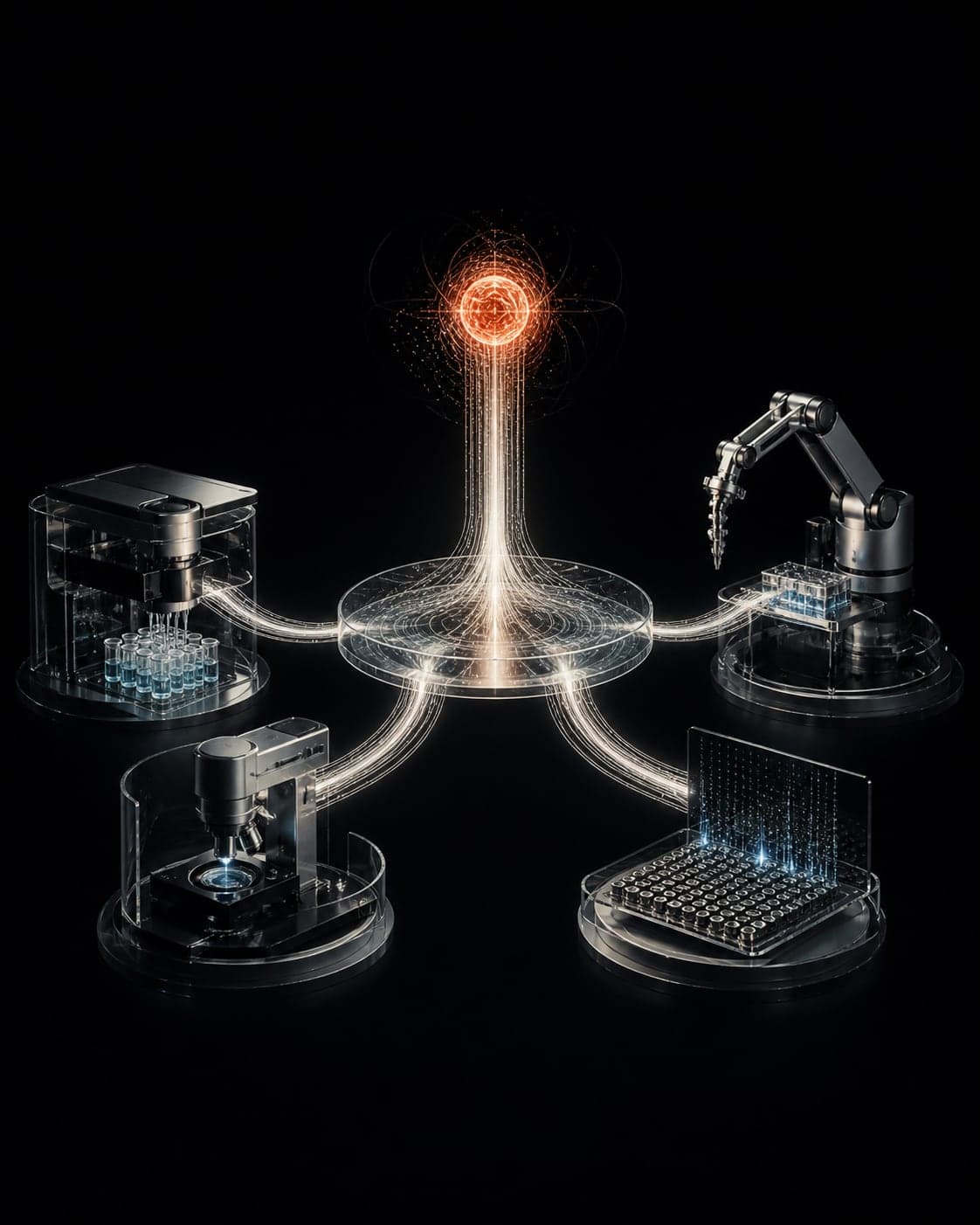
Anthropic has opened an early research preview of the Model Hardware Standard, or MHS, with partners in science, robotics, electronics, and manufacturing. The proposal is a shared layer for AI agents to discover, monitor, and operate programmable physical devices without building a completely separate integration for every machine.
MHS is not a new robot or a general claim that AI can safely run a laboratory by itself. Anthropic describes it as model-agnostic infrastructure for devices that already expose a programmable interface. The preview documents three paths from agent to hardware: Model Context Protocol, a command-line interface, and code files or APIs.
The design separates high-level reasoning from repeatable execution. An agent can sequence steps, read device state, and adjust parameters, then package stable operations into deterministic code so the model does not need to reason through every low-level action in real time. Device descriptions can also include natural-language characteristics and safety limits that the driver exposes to the agent.
A featured Genentech proof-of-concept connected a liquid handler, robotic arm, and plate reader for a protein assay workflow. According to the case study published by Anthropic with Genentech contributors, Claude coordinated trial transfers and analysis across the instruments. Those observations are partner-reported results, not independent benchmarks.
The limitations are as important as the demonstration. Anthropic says present models still struggle with spatial, physical, chemical, and biological constraints. In the Genentech example, experts had to explain that a recurring error came from bubbles in a viscous sample rather than from software. That is precisely the kind of real-world failure that makes oversight, explicit limits, and deterministic recovery procedures essential.
MHS is not yet open source, does not work with hardware that lacks a programmable interface, and is not broadly deployed. Anthropic says the research-preview period will be used to develop safety evaluations, strengthen deployment guidance, and expand device support before a public release.
The durable signal is narrower than the autonomous-lab headline. Physical AI needs a reliable translation layer between general models and specialized machines. If that layer can standardize device discovery, state, controls, and safety boundaries, it could reduce custom integration work across laboratories and factories. Whether MHS becomes that layer will depend on interoperability, driver quality, independent validation, and how carefully human approval is designed into high-risk actions.